
Rockingham County Release Date Types
A projected release date is an estimate produced under the current judgment, sentence rules, credit calculation, and record status. It looks forward. An actual release date records an event that has already happened. Keep the two labels intact. A forecast can move, while an actual entry should be read with the release type and current status to learn whether the person entered the community or another agency's custody.
Pretrial detainees at the Rockingham County Detention Center do not have a sentence-based release date. Their custody can end after bond is satisfied, a court order issues, charges resolve, or another legal basis is met. Processing and a final hold check still occur after the legal authority arises. A short county sentence can have a computed end date, but the sheriff or local custodian applies court credit and lawful earned-time rules. No official Rockingham online calculator or published county projection field was found.
For state prison, NCDAC calls the field a projected release date. It may appear for an active term in Offender Public Information. After release, the completed release history and current status are stronger evidence. A person can leave prison for post-release supervision, which ends physical confinement but does not end the sentence's community-control phase.
Run a Rockingham Release Date Lookup
Identify the custodian before searching. A Rockingham arrest followed by bond or a short local term belongs with the sheriff and court. A felony commitment to NCDAC belongs in the statewide offender record, even if the person is housed far from Rockingham County. The court judgment connects the local case to the prison term.
- Obtain the case number, judgment, offense date, sentence terms, and prior-confinement credit.
- Decide whether the person is pretrial, serving a county term, or committed to NCDAC.
- For state custody, search NCDAC Offender Public Information by offender number or a broad name match.
- Open the matched record and note current status, projected date, actual history, sentence entries, and access date.
- For a county term, ask Rockingham Detention Services for the sentence start, court credit, earned-time award, and current calculation.
- After the event, replace the forecast with the actual release entry and verify any receiving agency.
NCDAC's offender number is the best state key because it stays with the person through release and return. If it is unknown, start with surname and enough of the first name to find plausible records. Add age, birth date, race, sex, or middle initial only to resolve matches. Too many incorrect filters can suppress the right record. OPI reaches back to state records from 1972 and expressly excludes county-jail-only data.
The official OPI search form displays the state fields and status choices used for a Rockingham County release date lookup.
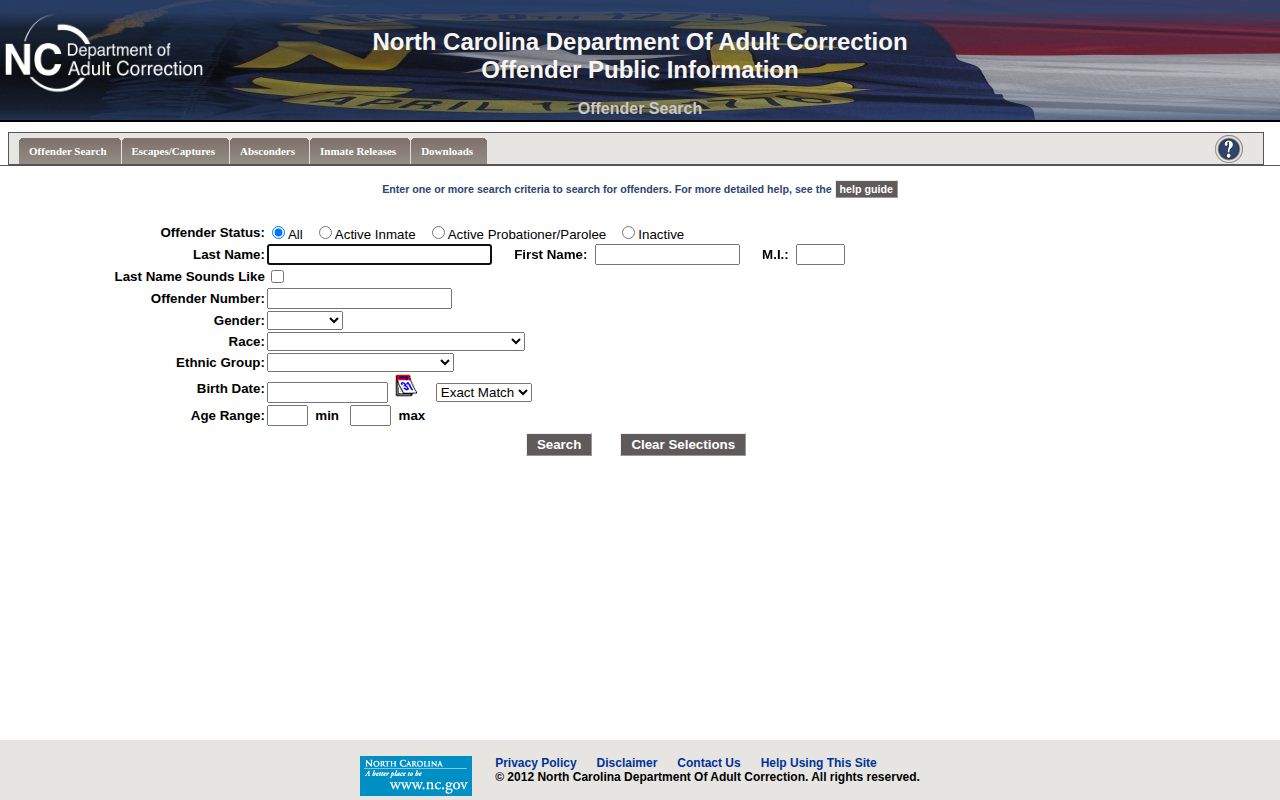
The form's Inactive and Active Probationer/Parolee choices are important when the person has left prison or remains under community supervision.
Note: An NCDAC no-result cannot disprove a Rockingham County booking, bond release, or county-only sentence.
Read Rockingham Release Date Records
A state detail record contains a chronology, not just one useful date. Match the offender number, conviction county, offense dates, admissions, and sentence entries before relying on it. “Active Inmate” means a current NCDAC prison term. “Active Probationer/Parolee” means community supervision. “Inactive” means the person is no longer active in the covered NCDAC incarceration or supervision episode. None of those labels states the exact door or time of a Rockingham jail exit.
| Record field | How to use it |
|---|---|
| Projected release date | Treat as a changeable estimate under the current calculation |
| Actual release entry | Use as evidence of a completed NCDAC event |
| Current status | Check whether prison or supervision remains active |
| Minimum and maximum terms | Read the judicial sentence structure, not a flat percentage |
| Admission and incarceration history | Place the date within the correct custody episode |
| Supervision entry | Separate prison release from final discharge |
A next custody-review date is not a parole-review date or release date. Custody review concerns security classification. A move to a lower level does not itself establish release. The dedicated NCDAC Inmate Release Search can query state-prison releases by county, year, and month, but that tool is not a Rockingham sheriff feed and does not replace the county release sheet.
North Carolina Sentence Date Rules
North Carolina does not have a sound universal “serve 85 percent” rule. NCDAC's sentencing guidance says Structured Sentencing applies to felonies committed on or after October 1, 1994. The court sets a minimum and maximum. The person must serve the judicial minimum, with ordered jail credit counted toward it. Earned time can move the expected endpoint from the maximum toward the minimum, but ordinary credit cannot reduce the term below that minimum.
G.S. 15A-1340.13(d) authorizes earned time for an activated felony term and states the key minimum-term limit, apart from its special Advanced Supervised Release treatment. G.S. 148-13 directs NCDAC to set earned-time rates and circumstances. It also sends those rules to local jail administrators for sentenced jail prisoners, which is why Rockingham's local custodian is the calculation source for an eligible county term.
Older cases require another path. Fair Sentencing applies to certain felony offenses from July 1, 1981 through September 30, 1994. NCDAC describes one day of good-time credit for each day of good conduct in that regime, subject to loss after discipline, plus gain time for qualifying work or programs. Pre-Fair cases and specialized sentences can differ. The offense date and governing judgment must be known before credits are discussed.
Note: A sentence percentage borrowed from another state can produce a false Rockingham County release date.
Rockingham County Jail Date Credits
A person serving an activated misdemeanor term locally follows a distinct statute. G.S. 15A-1340.20(d) authorizes earned time under lawful rules and caps the combined award at four days per month of incarceration. The cap does not grant four days automatically. Conduct, work, eligibility, the judgment, and applicable custodian rules still control the award.
Ask Rockingham Detention Services for the sentence start, prior-confinement credit in the judgment, earned-time award, and resulting calculation. The Detention Center's line is 336-634-3236 and operates around the clock. For a records issue, Sheriff Records lists 336-634-3235 and 336-634-3234 during regular weekday office hours. A focused request should identify the person, booking date, case, and existing date fields.
Advanced Supervised Release under G.S. 15A-1340.18 can create a special date for qualifying cases tied to sentencing ranges and completion of a risk-reduction plan. Some ASR calculations use an 80-percent concept. That specialized route is not a statewide 80- or 85-percent formula. Confirm that the judgment and OPI record show ASR before applying it to a named person.
Why Rockingham Release Dates Move
A projection is a snapshot. Work and full-time programs can earn credit. Transfer, discipline, removal from a job, or program completion can alter the calculation. Court action can do more. A vacated or amended judgment, resentencing, corrected jail credit, or a change in governing law can move the endpoint. Compare record dates before deciding that two systems conflict.
| Factor | Possible effect | Best source |
|---|---|---|
| Earned credit | Moves the maximum toward the lawful minimum | NCDAC or local custodian |
| Discipline or program change | Reduces or changes anticipated credit | Current corrections calculation |
| Concurrent or consecutive terms | Changes how multiple commitments combine | Judgments and sentence history |
| Amended court order | Changes the sentence or prior credit | Rockingham court file |
| New hold or detainer | May block community return after one term ends | Releasing and receiving agencies |
| Supervision revocation | Can return a released person to confinement | NCDAC chronology |
Prior-confinement credit deserves care. Time in the county jail because of the charge may count toward a state term if the judgment awards it. That does not make the county booking date an NCDAC admission date. The sheriff record proves county movement, the judgment proves awarded credit, and NCDAC applies it to the state sentence.
Note: When public dates conflict, seek the current calculation and judgment rather than choosing the earlier date.
Confirm Rockingham County Release Dates
After the date passes, look for an actual release entry and current status. An old release date cannot prove the person remains free of later cases, holds, or supervision returns. For a county event, request the release screen or custody history with the timestamp, type, and receiving agency. Pair it with the Rockingham court judgment from the eCourts Portal when the legal authority matters.
For state prison, the OPI release history and current status answer separate questions. A physical release can begin post-release supervision. That means the person left prison but remains under NCDAC community control until termination or discharge. A violation can produce a return to confinement. The Rockingham County VINE inmate check can add an event alert, but its agency feed does not replace the completed state or county record.
Under Structured Sentencing, post-release supervision can be built into the maximum term. NCDAC explains that the statutory release date to supervision is set by law, while the Post-Release Supervision and Parole Commission establishes conditions. Those roles should not be blended. The Commission does not select every prison release date. A later supervision discharge is another endpoint, and a revocation can create a return to confinement between release and final discharge.
Multiple sentences need the same care. Concurrent terms run together in a way consecutive terms do not. Separate cases may start or end at different times, and a later commitment can alter the visible endpoint. Read the incarceration history as a sequence. A date attached to one term may not answer when all lawful custody ends.
- Projected date
- A future estimate under the current sentence and credit calculation.
- Actual release
- A recorded custody event that has occurred.
- Detainer
- A request or hold from another authority that may affect where the person goes.
- Discharge
- The end of a corrections or supervision episode, not merely a prison exit.
Preserve the accessed-on date and exact source label. That small step prevents a stale projection from being repeated as a current fact. It also lets the next check show whether credits, a judgment, custody, or supervision changed.