
Rockingham County Supervision Types
North Carolina uses three distinct community statuses. Probation is a sentence imposed by a court. It may begin without any state-prison stay, so a probation entry does not by itself prove that someone was released from prison. Parole is conditional release before the end of a parole-eligible prison sentence. It now applies mainly to older sentencing regimes. Post-release supervision follows many felony prison terms under Structured Sentencing and forms part of the sentence. It begins after physical prison custody ends.
The NCDAC label Active Probationer/Parolee covers more than ordinary parole. Open the person’s chronology and sentence entries before describing the status. A probation term can arise at sentencing. A parole record usually points to an eligible legacy sentence and a Commission decision. A post-release entry can support the conclusion that state-prison custody ended, but the completed release entry gives the actual date.
| Status | What it establishes | What it does not establish |
|---|---|---|
| Probation | A court-ordered community sentence supervised by NCDAC | A prior state-prison release on that case |
| Parole | Conditional community release on a parole-eligible term | Final discharge from the sentence |
| Post-release supervision | Prison custody ended and statutory community supervision began | The exact exit point from the county jail |
Verify Rockingham County Supervision
Start with the NCDAC Offender Public Information Search. An offender number is the strongest key because NCDAC keeps it when a person leaves and later returns. If it is unknown, begin with a broad name query. Add demographics only to separate plausible matches. Select “All” when the history is unclear, then read the status, conviction, incarceration, release, and supervision entries together.
- Match the person by offender number, name, and available identity fields.
- Check whether the current label is Active Probationer/Parolee, Active Inmate, or Inactive.
- Read the event history for a completed prison release and the type of community supervision.
- Use the Community Supervision directory to find the current office roster.
- Ask the listed office to confirm public status and route the inquiry using the offender number.
Office assignment may follow residence and current NCDAC organization, not the county of conviction. Current management materials group Rockingham, Stokes, and Surry, but assignments and contact details can change. The live NCDAC roster is safer than an old address list. A Rockingham conviction does not guarantee that the supervising officer sits in Rockingham County.
Rockingham Release Versus Discharge
Release, revocation, and discharge mark different points. A person released from state prison onto post-release supervision has left the institution but remains in the sentence’s community-control phase. The Post-Release Supervision and Parole Commission sets conditions and can respond to violations. A revocation may return the person to prison for an authorized period. The record can then show release, return, another release, and a later final discharge.
Final discharge or termination means that the supervision case has ended. It is not the same as the date physical custody ended. Parole works in a similar way: the person lives in the community under conditions before the eligible sentence expires, and a violation can lead to a return to custody. When confirming a Rockingham County record, state which event the source supports: facility release, active supervision, return to custody, or final discharge.
Rockingham Supervision Absconder Records
The official NCDAC search menu includes an absconder search. An absconder is a person whom the supervision agency reports as having lost contact or failed to comply while under probation or parole supervision. The label is not a new conviction. It also does not show the person’s physical location. Use the state offender number where possible, compare the identity fields, and record the date the result was viewed.
A later arrest may place the person in a county jail before the state display changes. Likewise, disappearance from the absconder results does not explain whether the person was captured, discharged, died, or had a record corrected. Confirm the outcome with a later custody record or NCDAC. No separate official Rockingham County Sheriff supervision-warrant list was found, so the statewide NCDAC channel is the supported public starting point.
Rockingham Parole Review Records
Ordinary parole is largely a legacy system in North Carolina. Structured Sentencing ended ordinary parole for most offenses committed on or after October 1, 1994. Eligibility depends on the offense date, judgment, sentence, and exclusions, not merely the year someone was convicted. The official parole process explains that the Commission reviews case material without a formal hearing or an in-person meeting with the offender.
The official process page shows why there is no conventional public hearing calendar to search.
View the North Carolina parole process at its source before interpreting a review as a scheduled courtroom event.
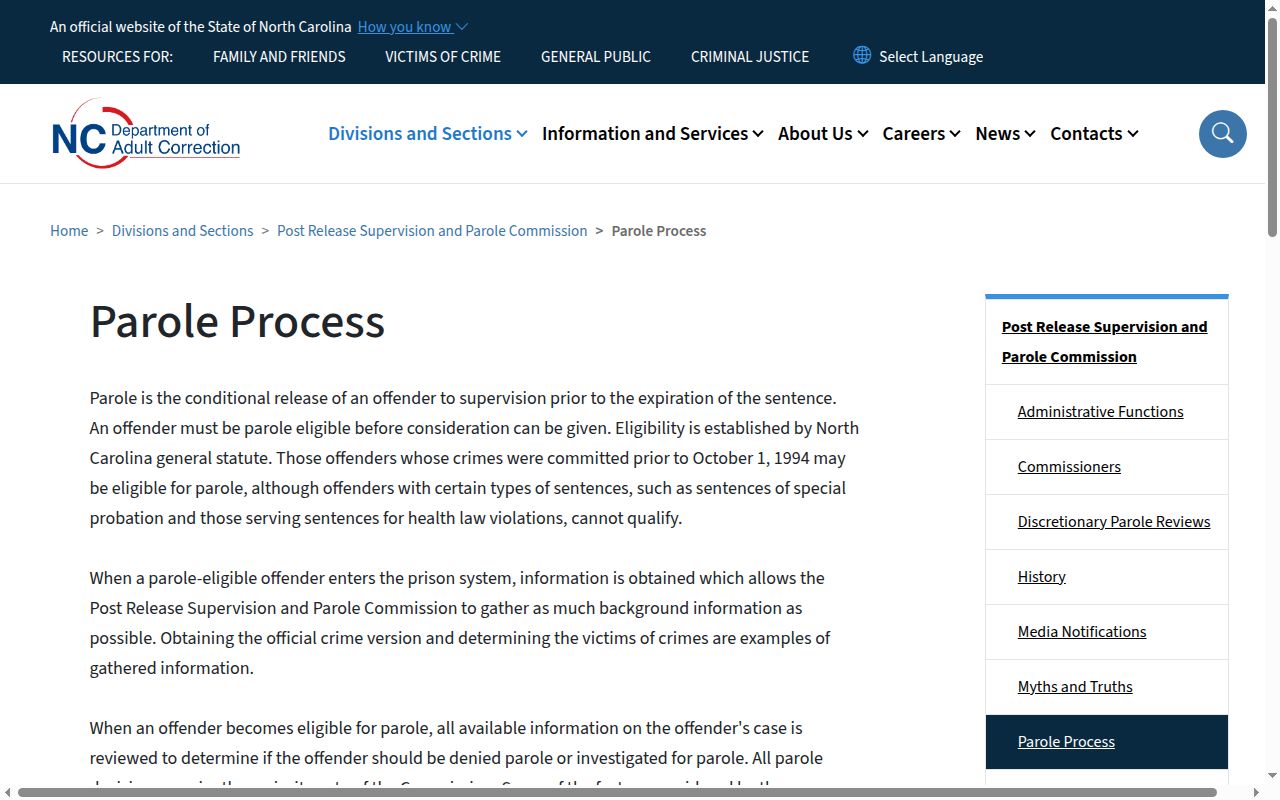
The process separates Commission review from field supervision and from the later physical release event.
Commission approval and a completed release are separate facts. The Commission decides parole for the limited eligible population and administers post-release matters, while NCDAC calculates the statutory release date and manages the custody record. The Commission states that it does not select or change the statutory date for release onto post-release supervision. A favorable review should therefore be followed by an OPI check for the later completed release event and current supervision status.
The Commission can be reached at 2020 Yonkers Road, 4222 Mail Service Center, Raleigh, NC 27699-4222, by phone at 919-716-3010, or at Parole.Commission@dac.nc.gov. Its files are substantially confidential. A public OPI status or published result may therefore be available even when internal votes, reports, and detailed reasons are not.
Rockingham Parole Monthly Results
The Discretionary Parole Reviews page is the closest public counterpart to a decision-results channel. It publishes monthly retrospective reports, not future hearing dates. Reports may list Regular Parole, Community Service Parole, Early Medical Release, and qualifying mandatory parole outcomes. They also use “Incomplete Decision” when more information is needed and “Suspend Decision” when consideration stops at that stage.
Open the official monthly parole review collection to check the reporting period and outcome terms.
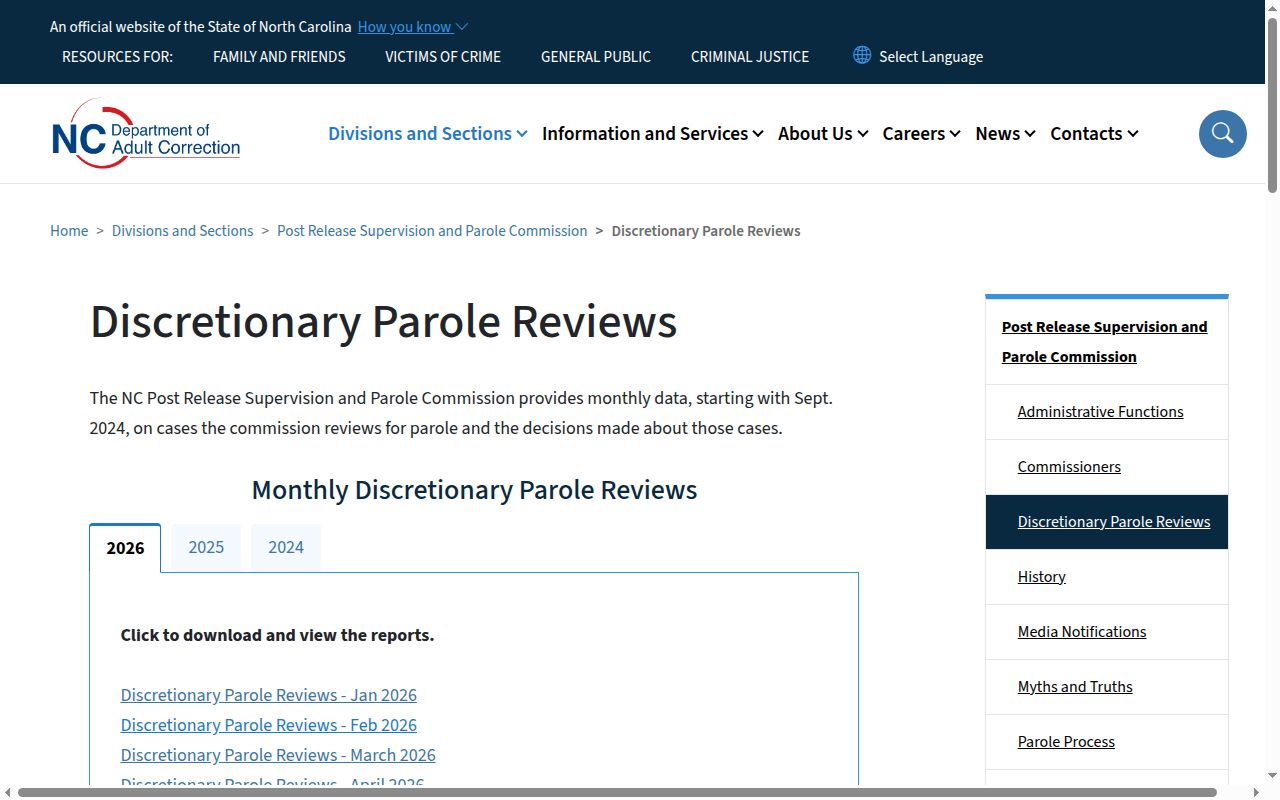
The collection reports past Commission work and should not be read as an advance calendar.
A grant still does not prove that physical release has occurred. Match any review result to the individual OPI record and later release entry. Denial reasons and most underlying Commission materials remain confidential. An interested person may learn that parole was denied and the next review period through the official notice process, but the full decisional file is not promised as a public record.
Some report terms need care. Regular Parole is conditional release before sentence expiration. Community Service Parole applies only within a defined older-offense framework and can include community service. Early Medical Release concerns qualifying prisoners referred under a specific health and incapacity statute. A 90-day Mandatory Parole category also belongs to a defined class of older felony terms. None is a general label for every person who leaves a North Carolina prison.
Rockingham Supervision Status Alerts
NCDAC Victim Support Services provides registered victims with information about probation or post-release conditions, hearings, final dispositions, intermediate sanctions, absconding and capture, case termination, discharge, and death. This separates the original prison-release event from what happens later in supervision. The service can be reached at 1-866-719-0108, Monday through Friday from 8 a.m. to 5 p.m., or at svc_dac_victimservices@dac.nc.gov.
NC SAVAN and VINELink can also deliver offered custody and supervision-event notifications. Use the correct NCDAC offender number because a county booking number is a different identifier. An alert supports the event reported by the contributing agency. It does not replace OPI or the supervising office for a present-status check, and general callers should not expect the same individualized information available to a registered victim.
The release notice and later supervision notices should be logged as separate events. A prison release notice indicates a change in physical custody. An absconding, capture, sanction, termination, or discharge notice describes a later supervision event. If a notice conflicts with OPI, preserve the notice date and ask the responsible NCDAC office to clarify the public status rather than choosing one label without support.
Rockingham Help After Release
Rockingham County Public Health maintains a distinctive local Re-Entry Programs resource. It connects people leaving custody with treatment, recovery support, harm reduction, primary care, and other health services. Public Health is at 371 NC Highway 65 in Reidsville and can be reached at 336-342-8140.
That resource serves a different purpose from supervision verification. It can help a released person navigate care and recovery, but it does not confirm parole, probation, discharge, or the terms of a case. For status, use OPI and the current Community Supervision directory. For support, use the county’s reentry resource and its linked guide. Keeping those roles separate prevents a service referral from being mistaken for a corrections record.